Rook Script
A blog about rook script, an alternative writing system for English
Rook Script Alphabet Tables
by Reductive Group
This post explores how consonants and vowels are organized in rook script, based on features of the sounds they represent. Hopefully it’s helpful for learning and understanding the alphabet. It also explains how rook script treats certain phonetic concepts both in spelling and writing, so future posts will refer back to this one. A previous post focuses on the sounds made by the letters, and future ones will focus on how the letters are used to spell words.
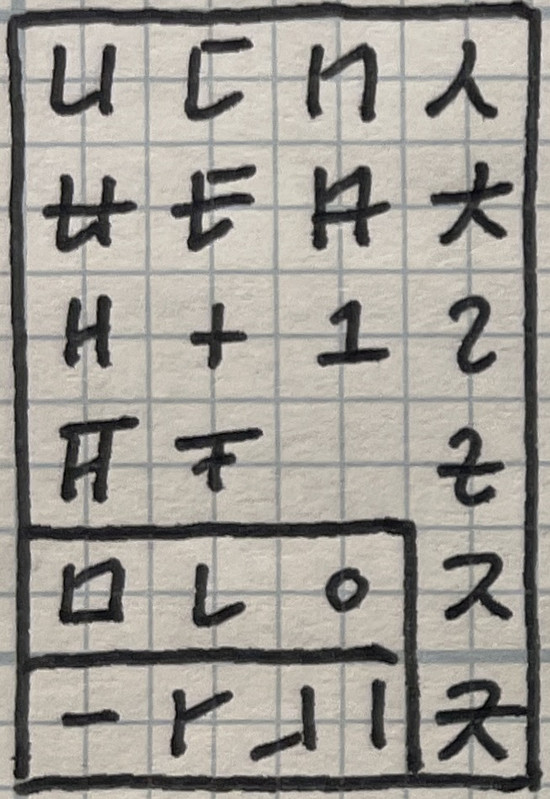
Rook consonants |
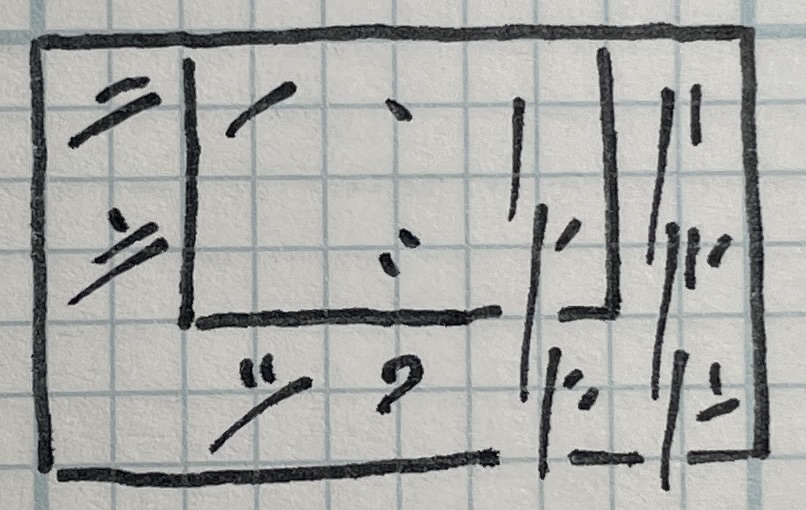
Rook vowels |
Consonant features
In English, consonants are determined by 3 features: place, manner, and voicing. When speaking, air is forced from the lungs into the mouth and nasal cavity, escaping through the lips and nostrils. The space in between—the throat, the mouth, and the nasal cavity—are known as the vocal tract. At any point in the vocal tract the flow of air can be disturbed: it can be stopped, redirected, and forced through narrow openings of different shapes, making sounds heard as consonants. This disturbance is called articulation and in English each consonant’s articulation can be associated with a characteristic place, manner, and voicing.
Place
When you say the words “peg” and “keg” out loud, the only difference between them is that “peg” begins with a /p/ sound and “keg” begins with a /k/ sound. To make the /p/ sound, you need to bring your lips together, so it is associated with the lips. We say the place of /p/ is the lips, or that /p/ is labial. On the other hand, to make the /k/ sound, you bring the back of your tongue upward into the roof of your mouth. We therefore associate /k/ with the velum, or soft palate, or say that /k/ is velar. In English all the places of consonants can be sorted from the front of the vocal tract (the lips) to the back (the throat).
| place | adjective | consonants |
|---|---|---|
| lips | labial | /p/, /b/, /f/, /v/, /m/, /w/ |
| teeth | interdental | /θ/ (th in think), /ð/ (th in those) |
| back of the gums | alveolar | /t/, /d/, /s/, /z/, /n/, /ɹ/ (r), /l/ |
| behind the back of the gums | post-alveolar | /ʃ/ (sh), /ʒ/ (zh), /tʃ/ (ch), /dʒ/ (j in job) |
| hard palate | palatal | /j/ (y in yuck) |
| soft palate | velar | /k/, /g/, /ŋ/ (ng) |
| vocal cords | glottal | /h/ |
Manner
Now consider the words “dip”, “nip”, “zip”, and “lip”. From the table above, the first sound in all four words is alveolar; what distinguishes them is the manner.
When you pronounce /d/, the air is completely blocked for a moment. We say the manner of /d/ is oral stop because your tongue stops the air in place. When you pronounce /n/, the air is not allowed out of your mouth, but is redirected through your nose. We say the manner of /n/ is nasal stop. The “oral” in “oral stop” refers to the absence of nasality. When discussing English, there is no confusion to simply call /d/ a stop and /n/ a nasal. When you pronounce /z/, the air is funneled turbulently through a small gap, producing a hissing sound. We say the manner of /z/ is sibilant, which is a type of fricative. English has a lot of fricatives (narrow gap and turbulent air) and only some of them are sibilant (producing a hissing sound), so I will usually refer to letters like /z/ as sibilants and use “fricative” for non-sibilant fricatives.
And finally, when you pronounce /l/, your tongue touches the back of your gums but the air is not hindered—instead it flows freely around the tongue on both sides. Being as specific as possible, we can say the manner of /l/ is lateral approximant (or simply “lateral”), meaning the air flows freely around the sides of the tongue. In English /l/ is the only lateral, but there are other approximants, or consonants where the air is allowed to flow freely. These include the (non-lateral) alveolar approximant /ɹ/ (the term “dorsal approximant” may be appropriate but I haven’t seen it used), and two glides, /w/ and /j/. In English the manners can be sorted roughly from most obstruent (stops) to most sonorant (approximants).
| manner | consonants |
|---|---|
| stop | /p/, /b/, /t/, /d/, /k/, /g/ |
| affricate (stop releasing into fricative) | /tʃ/, /dʒ/ |
| (non-sibilant) fricative | /f/, /v/, /θ/, /ð/, /h/ |
| sibilant | /s/, /z/, /ʃ/, /ʒ/ |
| nasal | /m/, /n/, /ŋ/ |
| approximant | /w/, /ɹ/, /l/, /j/ |
Voicing
Finally, consider the words “teeth” and “teethe”; they differ by only the last sound. “Teeth” ends in /θ/, sometimes referred to as “soft th”, and “teethe” ends in /ð/, or “hard th”. The feature that distinguishes them is voicing, or vibration of the vocal cords: /θ/ is unvoiced, while /ð/ is voiced. Stops, affricates, fricatives, and sibilants in English usually come in voiced/unvoiced pairs. Nasals and approximants (as well as vowels) are all voiced in English, but they can also be seen as neutral since they don’t exert much influence on the voicing of nearby sounds.
| voicing | consonants |
|---|---|
| unvoiced | /p/, /t/, /k/, /f/, /θ/, /h/, /s/, /ʃ/, /tʃ/ |
| voiced | /b/, /d/, /g/, /v/, /ð/, /z/, /ʒ/, /dʒ/ |
| neutral | /m/, /n/, /ŋ/, /w/, /ɹ/, /l/, /j/ |
In rook script voicing is especially important. Note that in the consonant table, all the voiced consonants contain a wide horizontal stroke. For most letters, this stroke appears near the middle, but it is at the top of the letters v and dh. The stroke is typically written so wide it overlaps the surrounding consonants. That is, if any consonant in a consonant cluster is voiced, then the voicing stroke is written through all the consonants in the cluster, typically as the last stroke of the cluster. It is very rare that a consonant cluster will contain both voiced and unvoiced consonants.
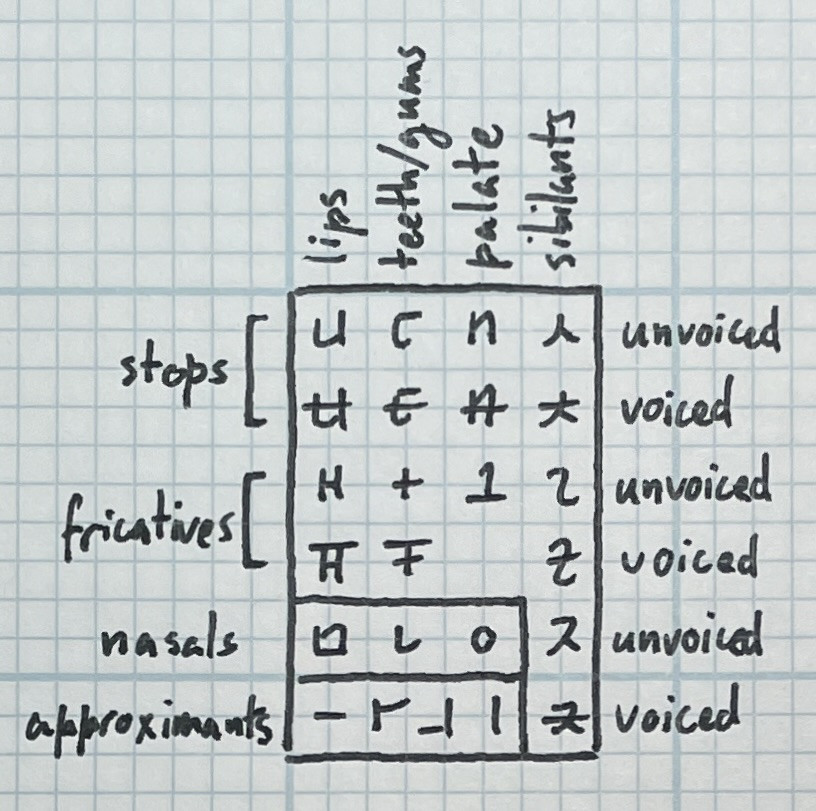
The rook consonant table is loosely organized around the features of place, manner, and voicing
The vowel space
In English, vowels vary considerably between dialects. Bear in mind that this is a discussion of the particular English that I speak.
Vowels in English are characterized by two continuous variables, and can be plotted on a plane in what is called the vowel space. The vowel space can be visualized as a triangle pointing downward with 3 extreme vowels at the corners. At the bottom is /a/, the sound you make to allow a doctor to see your tonsils, but not quite a sound of American English. At the top-left is /i/, the vowel in “eat”; and at the top-right is /u/, the vowel in “ooze”.
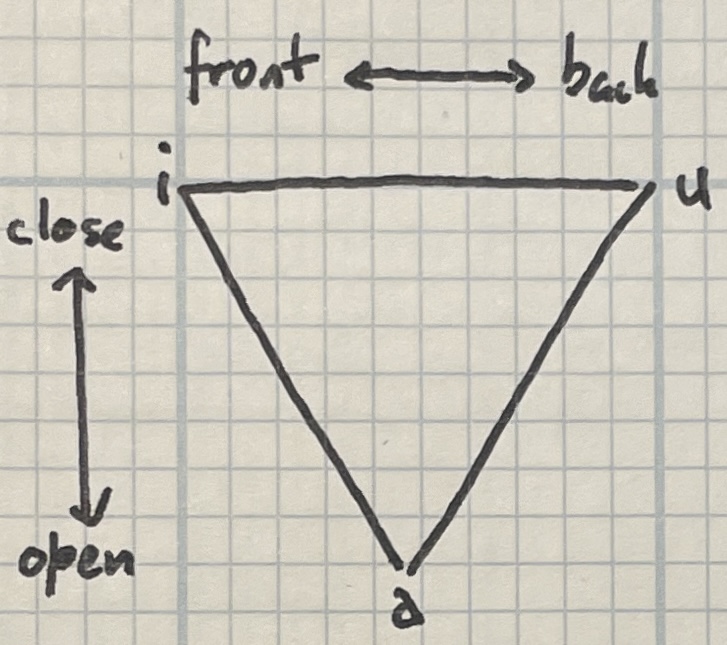
The vowel space can be visualized as a triangle. Two continuous variables, frontness/backness and openness/closeness, describe the positions of vowels relative to the extreme vowels /a/, /i/, and /u/
When navigating the vowel space, it’s helpful to know the names of the directions. The left side is the front and the right side is the back, with the center in between; vowels towards the top of the space are close and vowels towards the bottom are open, with mid vowels in between. These descriptions come from an outdated, but mnemonically useful, mapping of the vowel space onto the vocal tract. It was once believed that vowels have a vertical (open/close) and horizontal (front/back) place, a 2-dimensional analogue to the place of a consonant (front/back only). In modern analysis, position in the vowel space is determined by formants, which are ratios that appear in a sound’s frequency spectrum.
Something amazing about languages is that although vowels may move, merge, and split over time, vowel systems as a whole preserve a degree of symmetry and logic. Rook script takes advantage of that symmetry, splitting the vowel space into six regions each represented by a short vowel. There are then five long vowels, one for each outer region of the vowel space, and three diphthongs. The weak vowel does not fit this scheme, and will not be discussed on this page, beyond to say that its region in the vowel space is usually covered by the letters i and ə.
The short vowels of rook script are not actually pronounced any shorter than the long vowels. However, they are checked, meaning they prefer be followed by at least one consonant in the coda and rarely end words. They are:
| sound | position | rook romanization |
|---|---|---|
| /ɪ/ | close front | i |
| /ɛ/ | mid front | e |
| /æ/ | open front | a |
| /ɔ/* | mid back | o |
| /ʊ/ | close back | u |
| /ʌ/ | mid central | ə |
*The letter o is not used officially in rook script, as /ɔ/ is not phonemic in my dialect. However, for personal use, you are encouraged to spell words in rook script as you would pronounce them. If you pronounce “cot” and “caught” distinctly, having a letter o might be useful for the “caught” vowel.
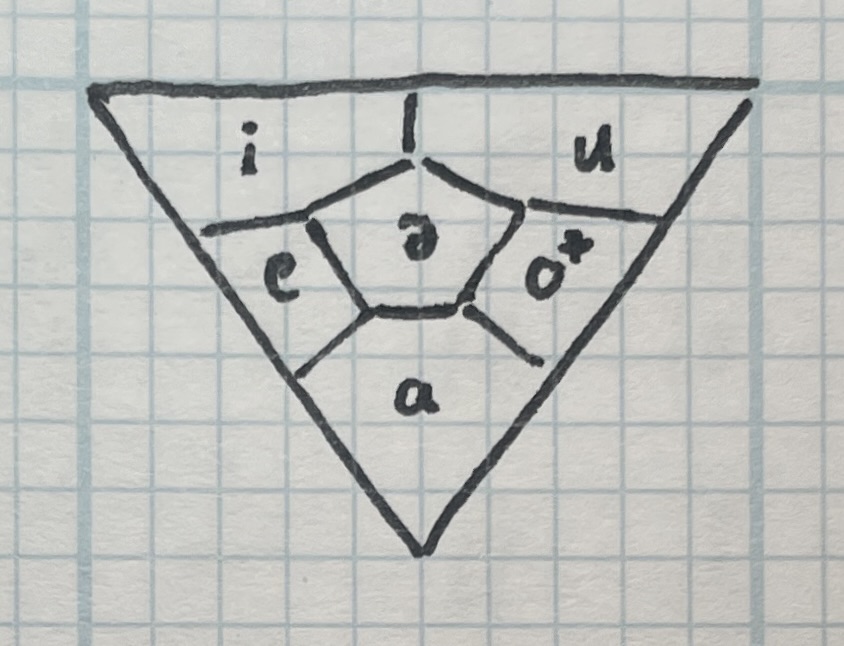
Regions of short vowels in vowel space
The five long vowels of rook script are unchecked, meaning they do not need codas. Three of them (ii, aa, uu) are monophthongs, and are romanized as doubled short vowels. The other two (ei, ou) are usually diphthongs, but are considered long vowels rather than diphthongs because they can be realized as monophthongs (for example when followed by r or l). The long vowels are:
| sound | traditional IPA | rook romanization |
|---|---|---|
| /i/ | [iː] | ii |
| /ei/ | [eɪ] | ei |
| /ɑ/ | [ɑ] | aa |
| /ou/ | [oʊ] | ou |
| /u/ | [uː] | uu |
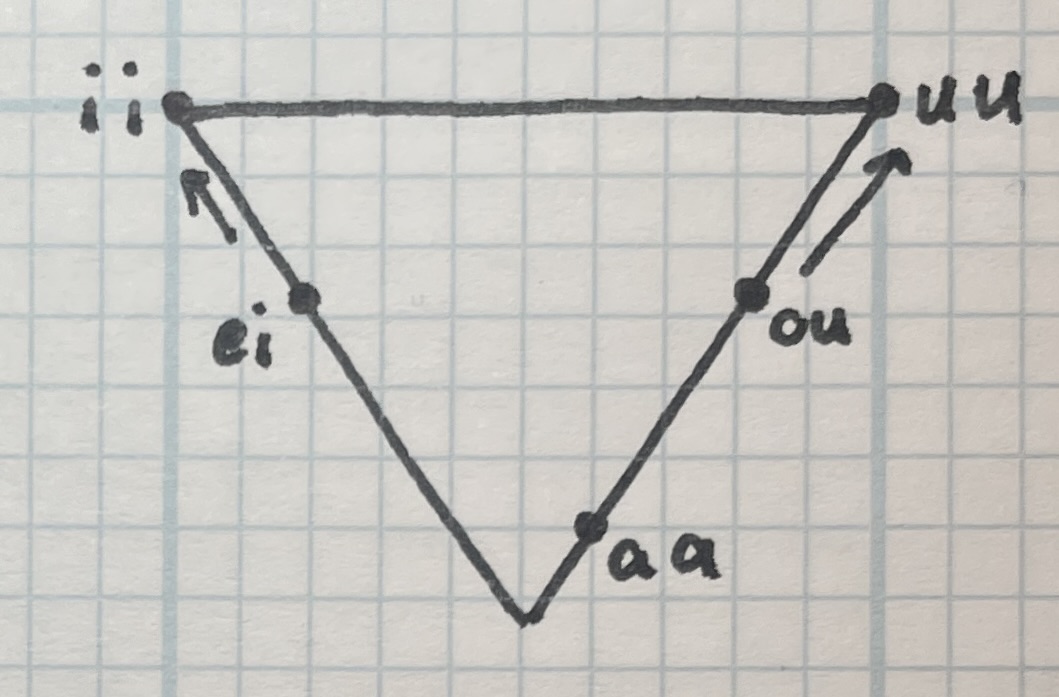
Positions of long vowels in vowel space. Ei and ou are shown with direction of movement
And finally, the diphthongs:
| sound | traditional IPA | rook romanization |
|---|---|---|
| /ai/ | [aɪ] | ai |
| /au/ | [aʊ] | au |
| /oi/ | [ɔɪ] | oi |
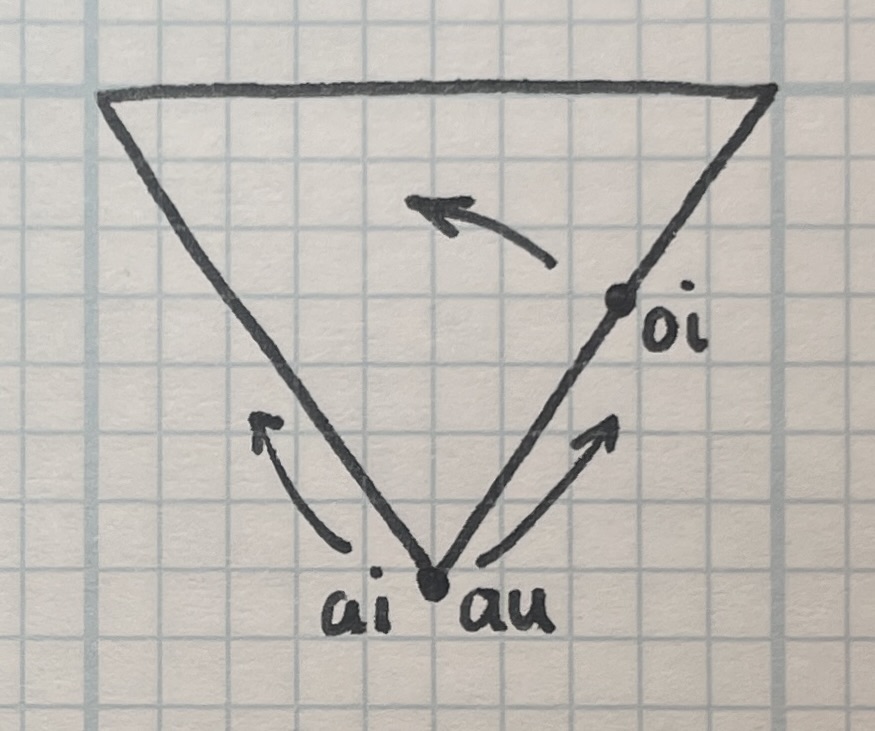
Positions of diphthongs in vowel space, with direction of movement
Putting the three categories together, we have the vowel table:
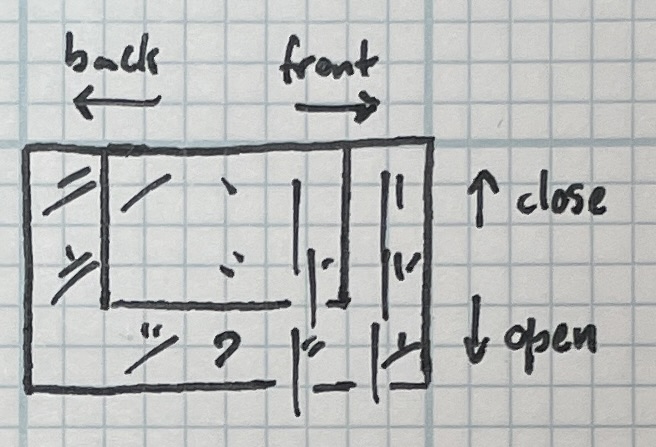
The rook vowel table is loosely organized around the two dimensions of the vowel space, with long vowels and diphthongs around the outside
In the standard rook vowel table, note that the left and right are reversed from the traditional depiction of the vowel space: in the table, the back vowels are on the left and the front vowels are to the right. This is intended to highlight the similarity in form between the consonants /w/ and /j/ and the vowels /u/ and /i/, respectively. It’s unfortunate but conventional to call /w/ a labial consonant and /u/ a back vowel when they are nearly the same sound.
tags: lesson